Posts

PRCS KP Conducts Interactive Session on Mental Health and Psychosocial Support at IMSciences Peshawar

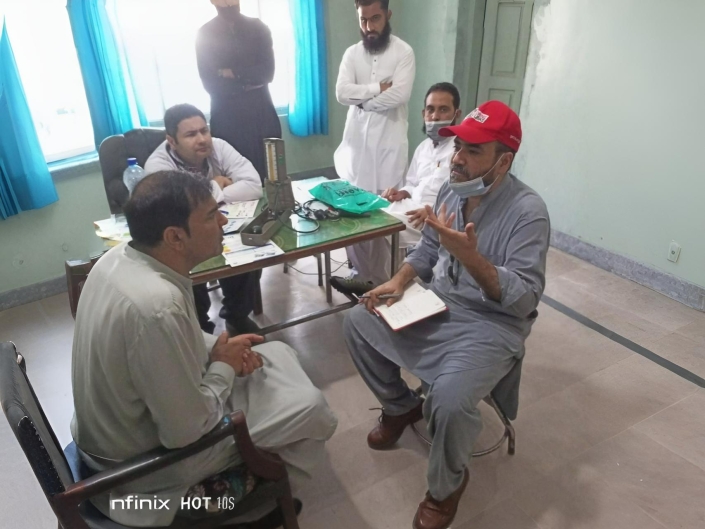
On the invitation of the Institute of Management Sciences (IMSciences), Peshawar, representatives from the Pakistan Red Crescent Society, Khyber Pakhtunkhwa Branch (PRCS KP)Ms. Samreen Afridi, Assistant Director – Community Engagement & Accountability (CEA) and Protection, Gender & Inclusion (PGI), and Mr. Zeeshan Asghar, Information Management & Reporting Officer — conducted an interactive awareness session with BS Psychology students on the theme “Integration of Mental Health and Psychosocial Support (MHPSS) during Emergencies and Disasters in Khyber Pakhtunkhwa.”

Promoting Mental Well-being in Humanitarian Response

The session aimed to enhance students’ understanding of the critical role of Mental Health and Psychosocial Support (MHPSS) in humanitarian action, particularly during disasters and emergencies. It highlighted the psychological and emotional impacts that crises can have on individuals, families, and communities, and the importance of timely psychosocial interventions to promote recovery and resilience.

Ms. Samreen Afridi discussed how PRCS KP integrates MHPSS into its disaster response and recovery operations, ensuring that the psychological needs of affected populations are addressed alongside their physical well-being. She emphasized that mental health support is a fundamental part of humanitarian response and that inclusive and community-driven approaches are essential to restoring hope and stability after traumatic events.

Understanding PRCS’s Role in Community Resilience

Mr. Zeeshan Asghar briefed participants on the PRCS’s ongoing programs and strategies for strengthening community resilience in Khyber Pakhtunkhwa, particularly through awareness campaigns, capacity-building workshops, and volunteer engagement. He elaborated on the importance of effective information management and coordination in responding to the mental health needs of vulnerable groups during crises such as floods, earthquakes, or conflict-related displacement.

Interactive Learning and Student Engagement

The session was designed to be interactive, allowing psychology students to engage with real-life examples, case studies, and field experiences shared by the PRCS team. Participants discussed the challenges of addressing mental health issues in disaster settings and explored how future professionals in psychology can contribute to humanitarian interventions through empathy, counseling, and psychosocial support.

Students expressed appreciation for the PRCS team’s visit, describing the session as inspiring, educational, and deeply relevant to their field of study. Many noted that it provided valuable insights into how psychological expertise can be applied in real-world humanitarian contexts.

Commitment to Mental Health and Humanitarian Excellence

The session concluded with an acknowledgment of the PRCS KP’s commitment to promoting mental well-being and psychosocial resilience as an integral part of disaster management and community support. Such collaborations between academic institutions and humanitarian organizations foster greater awareness, empathy, and preparedness among future professionals, ensuring a more resilient and compassionate society.

PRCS KP Conducts Orientation Session on Restoring Family Links (RFL)

The Pakistan Red Crescent Society Khyber Pakhtunkhwa (PRCS KP) organized a one-day orientation session on Restoring Family Links (RFL) under the supervision of the RFL Manager, PRCS KP. The session brought together newly appointed staff from the Norwegian Red Cross (NRC), the International Federation of Red Cross and Red Crescent Societies (IFRC), the International Committee of the Red Cross (ICRC), and core team members of PRCS.

The session aimed to enhance the understanding of participants—both new and existing staff—regarding the Restoring Family Links (RFL) services offered across Pakistan. The initiative focused on building the capacity of humanitarian workers to support the restoration of family connections, particularly for individuals and families separated due to conflict, disaster, migration, or other humanitarian crises.

Strengthening Humanitarian Response Through RFL

During the orientation, the RFL Manager briefed participants on the fundamental principles, operational mechanisms, and coordination structure of RFL activities implemented nationwide. The session covered key aspects such as tracing requests, restoring contact between separated family members, family reunification, and the importance of maintaining confidentiality and dignity in handling sensitive cases.

Participants also gained insights into how RFL operations align with the Red Cross and Red Crescent Movement’s global humanitarian mandate—to protect family unity and uphold human dignity in times of crisis.

Interactive Learning and Shared Experiences

The session provided an engaging platform for participants to exchange experiences and discuss practical approaches to improving RFL service delivery. Through interactive discussions, case studies, and real-life examples, the attendees explored how technology, coordination, and community outreach can be effectively used to trace and reconnect separated families.

Commitment to Humanitarian Excellence

At the conclusion of the session, participants expressed their appreciation for PRCS KP’s initiative, describing the orientation as informative, insightful, and highly valuable for enhancing professional capacity. They emphasized that such learning opportunities not only strengthen staff understanding of RFL services but also contribute to improving the quality and reach of humanitarian assistance provided to those in need.

The Pakistan Red Crescent Society Khyber Pakhtunkhwa remains committed to upholding the humanitarian values of the Red Cross and Red Crescent Movement by ensuring that families torn apart by crises can once again be reunited, restoring hope and connection where it is needed most.

Empowering Youth for Inclusive Humanitarian Action — PRCS KP Organizes Orientation Session on CEA, PGI, and YABC in Swat

The Youth & Volunteer (Y&V) Department of the Pakistan Red Crescent Society (PRCS) Khyber Pakhtunkhwa, under the IFRC-DREF initiative, organized a comprehensive orientation session on Community Engagement and Accountability (CEA), Protection, Gender and Inclusion (PGI), and Youth as Agents of Behavioral Change (YABC) at the Government College of Management Sciences, Swat, on November 7, 2025.

The orientation brought together 44 enthusiastic volunteers from across the district, marking another step forward in PRCS’s ongoing efforts to equip young people with the knowledge and tools to serve their communities more effectively and inclusively.

Building Understanding of Inclusive Humanitarian Action

The sessions on CEA and PGI were facilitated by Ms. Sumreen Afridi, Assistant Director CEA & PGI, PRCS KP. She highlighted the importance of community-centered approaches in humanitarian work, where people affected by crises are treated not merely as beneficiaries but as active participants in decision-making and response efforts.

Ms. Afridi emphasized that accountability, transparency, and inclusion are the cornerstones of effective humanitarian service delivery. She further discussed gender-sensitive approaches and protection mechanisms designed to ensure that humanitarian actions respect and uphold the dignity and rights of all, including women, children, persons with disabilities, and marginalized groups.

Youth as Catalysts for Behavioral Change

The YABC (Youth as Agents of Behavioral Change) session was led by the Assistant Director Youth & Volunteer (Y&V), PRCS KP, who engaged participants through dynamic discussions and participatory activities. The session explored how youth can play a transformative role in promoting peace, empathy, and social cohesion within their communities.

Volunteers were encouraged to act as role models and community leaders, spreading messages of tolerance, mutual respect, and humanitarian values. The YABC approach empowers young people to influence positive behaviors among peers and inspire others to contribute toward creating a more compassionate society.

Interactive Learning and Volunteer Empowerment

Throughout the day, volunteers took part in interactive exercises, group reflections, and scenario-based simulations, enhancing their understanding of how PRCS integrates CEA, PGI, and YABC into its field operations. These practical sessions helped participants connect theoretical knowledge with real-world humanitarian challenges faced during emergencies, disasters, and community outreach activities.

Participants expressed appreciation for the opportunity to learn and share experiences, noting that such orientations deepen their understanding of the Red Cross and Red Crescent Fundamental Principles — humanity, impartiality, neutrality, independence, voluntary service, unity, and universality — which guide every action of PRCS.

Collaboration and Acknowledgment

The PRCS KP team extended heartfelt thanks to the PRCS Swat Branch for their active support and facilitation in organizing the session. Their assistance ensured the smooth conduct of the event and underscored the value of strong branch-level engagement in volunteer development.

This initiative reflects the PRCS KP’s firm commitment to empowering youth, promoting inclusive humanitarian practices, and strengthening community resilience through volunteer-led action and education.

By nurturing a generation of compassionate, skilled, and responsible volunteers, PRCS KP continues to uphold its mission of serving humanity and fostering positive behavioral change at the grassroots level.

PRCS KP Conducts First Aid Simulation Exercise on Mass Casualty Incident in Swat

The Pakistan Red Crescent Society Khyber Pakhtunkhwa (PRCS KP), with the support of the International Committee of the Red Cross (ICRC) and in collaboration with Rescue 1122, organized a First Aid Simulation Exercise on Mass Casualty Incident (MCI) at the PRCS Swat Branch.

The exercise was designed to provide hands-on experience to the Emergency Response Team (ERT) members and Rescue 1122 personnel, enhancing their preparedness and coordination during large-scale emergencies.

During the simulation, participants demonstrated practical first aid, triage management, and firefighting skills in a controlled, yet realistic environment. The scenario replicated a mass casualty situation, allowing responders to apply their training in assessing injuries, prioritizing patients, performing emergency bandaging, transporting casualties on stretchers, and managing on-site coordination effectively.

Throughout the activity, PRCS volunteers and Rescue 1122 staff worked side-by-side to ensure timely response and efficient teamwork—key components in real-life disaster or emergency operations. The exercise highlighted the importance of communication, mutual support, and rapid decision-making in saving lives when every second counts.

PRCS Khyber Pakhtunkhwa extends sincere gratitude to the ICRC and Rescue 1122 Swat for their technical assistance and continuous support in strengthening the skills and capacity of volunteers and staff. This initiative is part of PRCS KP’s ongoing commitment to enhancing community resilience and ensuring a prompt humanitarian response in times of need.